Wholesale, Professional Investors and Advisers only
The information, products and services described in this website are intended solely for persons in Australia who are wholesale clients within the meaning of section 761G of the Corporations Act 2001 (Cth). By clicking Confirm below, you confirm that:
You are a wholesale client for the purposes of section 761G of the Corporations Act 2001 (Cth); and
You accept all of the Terms and Conditions of this website.
This investor update is to explain the addition of Energy as a Sage Group in our monthly reporting across all Sage Capital funds and mandates. Energy became a Sage Group on 1 October 2026 and has been reported as its own group since our October 2026 portfolio update.
Importantly, there has been no change to the portfolios’ holdings or investment process. The change relates to how Energy positions are grouped: they are now balanced against each other, and are reported as their own group, rather than within the Resources group.
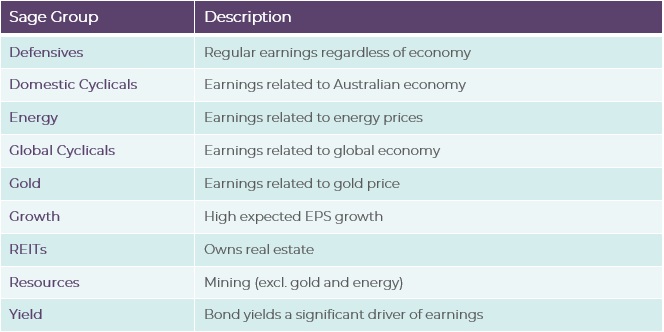
Sage Groups as of 1 October 2026
What Changed
Energy becomes the ninth Sage Group and the first group we have added since Sage Groups were established at inception in 2019. Although individual stocks have moved between groups over that time, the underlying framework and investment process remain unchanged.
The Energy group covers oil and gas producers, coal and uranium miners, fuel refiners, integrated energy retailers and energy services.
Within the S&P/ASX 200, the Energy group comprises 15 stocks, representing about 6% of the index. Most of these stocks were previously part of the Resources group. Ampol (ASX: ALD) and Viva Energy (ASX: VEA) moving from Domestic Cyclicals, and Origin Energy and AGL Energy (ASX: AGL) from the Defensives group.
Why We Made the Change
In general, we want each Sage Group to represent a group of stocks that behave similarly to each other under a variety of market conditions. By constructing our portfolio with controlled exposure to these groups, we can hedge the portfolio for sudden shifts in sentiment and the macro environment.
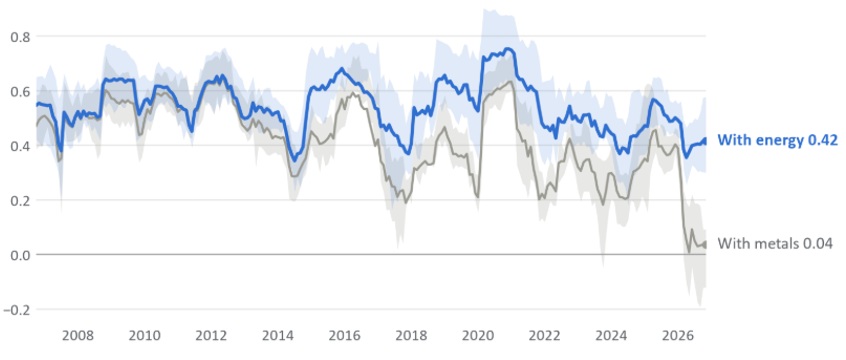
Since 2014, Energy stocks have traded differently to other resources stocks and responded differently to macroeconomic and geopolitical shocks. The recent energy crises, including the invasion of Ukraine, and disruption in the Strait of Hormuz, have reinforced this distinction.
Putting Energy into its own group follows the same logic that made Gold its own group: Gold also moves on drivers unrelated to other metals. This change to separating Energy gives us a better risk lens across the entire portfolio and does not change Sage Capital’s investment process.
Sage Capital's investment process is built around nine Sage Groups - clusters of stocks that share macroeconomic drivers rather than a GICS sector. Positions are sized so that the shared drivers are neutralised within each Group, leaving stock-specific return as the key source of returns.
Energy Stocks’ Co-Movement with Metals has Broken Down
Average 52-week correlation of ASX 200 energy stocks with energy and with metals stocks. Shaded area represents the middle half of stocks
Source: Sage Capital. Each Energy stock’s correlation with the equal-weighted average of the other Energy stocks and of Metals stocks, using Sage’s Energy and Resources ex-Energy classifications; stocks count only while in the S&P/ASX 200.
This information is for professional and wholesale investors only and has been prepared by Sage Capital Pty Ltd ACN 632 839 877 AR No. 001276472 (‘Sage Capital’). Channel Investment Management Limited ACN 163 234 240 AFSL 439007 (‘CIML’) is the responsible entity and issuer of units in the CC Sage Capital Equity Plus Fund ARSN 634 148 913 and the CC Sage Capital Absolute Return Fund ARSN 634 149 287 (collectively ‘the Funds’).
Channel Capital Pty Ltd ACN 162 591 568 AR No. 001274413 (‘Channel’) provides investment infrastructure services for Sage Capital and is the holding company of CIML. None of Sage Capital, Channel, CIML or their respective employees or officers (collectively, ‘the Beneficiaries’) make any representation or warranty, express or implied, as to the accuracy, reliability or completeness of this information and nothing contained in this information is or shall be relied upon as a promise or representation, whether as to the past or the future. Past performance is not a reliable indicator of future performance. All investments contain risk. This information should not be considered advice or a recommendation to investors or potential investors in relation to holding, purchasing or selling units in the Funds and has been prepared without take into account the objectives, financial situation or needs of any particular person. It is intended solely for wholesale clients (including sophisticated investors) as defined under sections 761G and 761GA of the Corporations Act 2001 (Cth). Before acting on any information you should consider the appropriateness of the information having regard to these matters, any relevant offer document, and in particular, you should seek independent financial advice.
For further information and before investing, please read the Product Disclosure Statement and Target Market Determination which are available from www.channelcapital.com.au/funds
SHARE
Subscribe
Please keep me up to date with the latest Fund updates and investment insights.
Thank you for your subscription.
Oops! Something went wrong while submitting the form.